The Taming of Black Thought
Original article by Takeshi Morisato for Aeon
Black philosophers now feature on Western curricula, but the European tradition diminishes their radicalism into reassurance
ho gets to decide what counts as philosophy? You might think that, if philosophers in the Western tradition read more Black and Asian philosophers, they would be more inclusive of other intellectual traditions. The first Black philosophy professor in Scotland, Tommy Curry, has argued that, on the contrary, consumption of minority thinkers could create devastating consequences for many fields of world philosophies, including Africana and Asian philosophy.
To explain this point, Curry termed this phenomenon ‘epistemic convergence’ in a series of articles in the 2010s. The idea itself can be traced back to W E B Du Bois’s idea of ‘double consciousness’, Frantz Fanon’s ‘sociogeny’, Huey Newton’s term ‘reactionary’, Steve Biko’s ‘Black consciousness’, and Sylvia Wynter’s adaptation of the ‘sociogenic principle’, to name but a few similar concepts. In line with this radical Black tradition, Curry argues that white academia has managed to integrate the same list of Black thinkers, not to critically challenge its traditional concept of humanity that has marginalised these thinkers, but rather to integrate them into the larger narrative that continues to justify and sustain its legitimacy. This creates the ‘interrogationist milieu’, where the historical works of people of African descent are constantly measured by the standards of white academia and, especially, in relation to its liberal ideology. They’re slotted into pre-existing narratives. Their radical challenge to any white-supremacist elements of the establishment is carefully redacted, revised, and integrated into the continuation of what we think of as the ‘proper’ form of philosophical thought in the history of Western philosophy. Their language – regardless of the fact that this language itself was, in many cases, forced upon them to speak about their lived experience in the process of describing their racialised (non-)being – is also paraphrased to avoid perceived offence (by, for example, not using the now archaic technical term ‘Negro’, which carried different connotations in the 1960s), softened through white analogy, or removed. This, Curry argues, creates a ‘methodological and derelictical crisis’ in our study of Black thought.
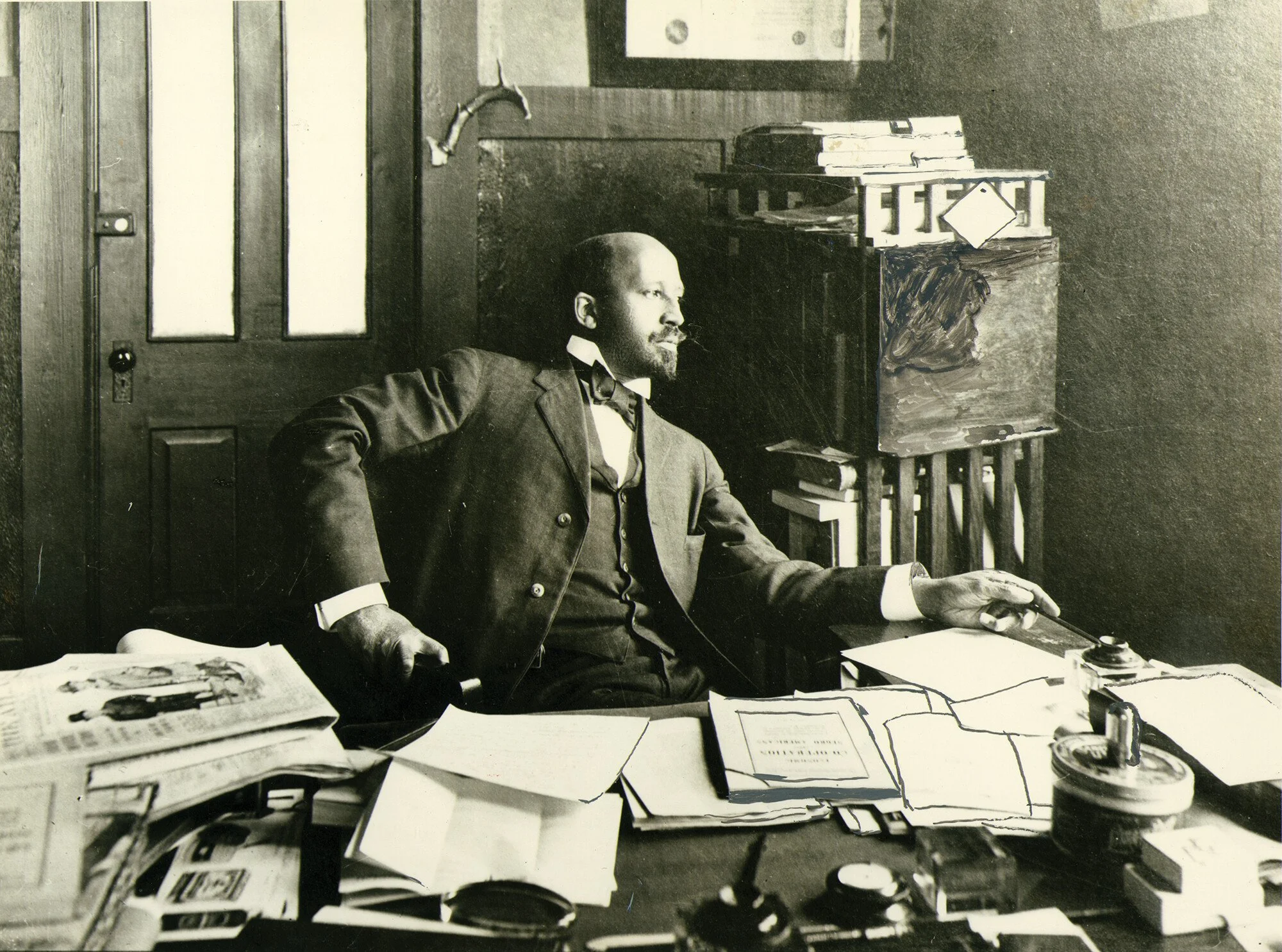
Photo courtesy: W.E.B Du Bois Collection, Special Collections and University Archives, UMass Amherst Libraries
We could spend pages on each of the Black thinkers I’ve mentioned and their analyses of racism, but we can see the essence of what they were trying to say in an early article of Curry’s titled ‘On Derelict and Method’ (2011). Curry argued that the recent rise of liberalism in the modern academy has allowed us to examine and cite the works of Africana philosophy insofar as they highlight the ‘inadequacies of traditional European thought’. Africana philosophy, in other words, has begun to enjoy increasing validation for its critique of the Anglo-European past. But, because it comes with tacit prejudices deeply rooted in the very tradition it criticises, which still dictates the terms of what counts as philosophical discussions, the whole process of integrating Black thinkers into the traditionally white/Western-style academy ends up validating what European philosophy thinks of as the proper form of being human (or any other major conceptions in philosophy). In other words, by reading the works of Black thinkers, our faith in the white establishment and white philosophy paradoxically increases, and the potential impact of radical philosophy is softened and turned into a kind of ‘racial therapy’ for Western philosophers.
Read full article on Aeon